Happy New Year – 2009!

On behalf of myself and LinuxQuestions.org I’d like to wish everyone a very happy new year. As the year comes to an end, it’s a great time to reflect on the year that passed and look forward to the year ahead. 2008 was another great year for LQ. We continue to roll out additional features a new functionality, while staying true to our core goals. This year we added almost 70,000 new members and over 400,000 new posts to the site. LQ ISO has now facilitated over 7.5 Million Linux downloads. I’m happy to report that in 2009 we have plans that should provide continued growth and further stability. We remain committed to remaining one of the friendliest and most active Linux communities on the web. It’s been a wild 8 and a half years – here’s to another great one.

I’d also like to take this time to thank each and every LQ member. You are what make the site great.

–jeremy

MySQL: Now and Then… and Dual License Community Impact

Stephen O’Grady recently posted a Q&A pertaining to the past, present, and future of MySQL. There’s been quite a bit going on at MySQL and Sun lately, but I’ll focus on one issue in this post – the impact of the current MySQL dual-licensing strategy. Stephen covers much more in his post, and I will be posting some additional MySQL-related thoughts soon. From the linked post:

A: Well, let’s remember what the dual license mechanism is and how it works. Here’s a basic description I wrote a while back:

A single entity such as MySQL is responsible for the overwhelming majority of all development on a given codebase. Anything they don’t produce themselves, they license. Very often this is practiced in conjunction with the dual-license model; because MySQL is responsible for virtually all of the development of the core code, they own or have licensed appropriately all of the involved IP. As such, they’re free to issue commercial licenses to those who would cannot or choose not to comply with the terms of the open source license – the GPL, in this case.

Generally, this model has served MySQL fairly well. By controlling the intellectual property, they retain the rights to relicense the code, thus protecting a revenue stream. They also were afforded a slightly greater protection from forks versus more collaboratively developed projects like Linux, in that they – theoretically – employed the majority of the people qualified and paid to work on the codebase at the lowest levels. But let’s come back to that.

What’s the catch to the model? In part, it’s that the burden of development is born almost entirely by the MySQL staff, but the more relevant concern here is the inability to consume external contributions – even if they’re excellent – without licensing them.

Stated more simply: as long as MySQL remains committed to the dual licensing model, it will be unable to accept the same patch set that open source only versions of the code can, because they do not share the same licensing concerns. Which is why we’ve seen these spring up, and possibly why the MySQL-derived Drizzle project has taken a different approach from its parent.

For a long time, most viewed the control that MySQL AB had as a strength, at least from a business perspective. With the high quality work that is now going on outside MySQL/Sun, however, that is increasingly not the case. Percona, Proven Scaling, OurDelta, Google and others are doing some really cool things these days. The current thinking for many is that the best bang for the buck when it comes to MySQL is now outside MySQL. That’s never happened before and I think it shifts the entire MySQL landscape. The question for Sun now becomes: when will the ability to consume external contributions outweigh the perceived benefits of the dual-license strategy that inhibits the consumption of those contributions? While Drizzle may change some of this, I think it’s a question Sun is going to have to answer (for its own good) sooner… rather than later.

–jeremy

I'm Back

Just a quick update to let you know that my blogging frequency should return to previous levels moving forward. Additionally, I just booked my flight to SCALE 7X. SCALE is one of my favourite conferences, and if you’re able to attend I highly recommend it. LQ is once again a proud sponsor.

–jeremy

Steal This Comic

From xkcd.com:

DRM

On the topic of DRM-free music, congratulations to Jono on his release of Severed Fifth, an album released completely under the Creative Commons Attribution ShareAlike license.

–jeremy

Ohio LinuxFest 2008

I’m just about to leave for the Ohio LinuxFest. This will be my second time attending the event. I had a great time last year and expect I’ll enjoy things once again. If you’re attending and would like to connect, drop me a line. I should be at Barley’s Brewing Company tonight for the pre-party. See you in Columbus.

–jeremy

MySQL cofounder David Axmark leaving Sun

From InfoWorld:

David Axmark, a cofounder and former lead engineer for MySQL, has resigned from Sun Microsystems a few weeks after another cofounder said he may also leave the company.

“I have thought about my role at Sun and decided that I am better off in smaller organisations,” Axmark wrote in his resignation letter, according to a blog post Tuesday from Kaj Arno, head of MySQL community relations.

“I HATE all the rules that I need to follow, and I also HATE breaking them. It would be far better for me to ‘retire’ from employment and work with MySQL and Sun on a less formal basis,” Axmark wrote. His last day with Sun will be Nov. 10, Arno said via instant message from Germany.

Axmark filled several important roles at MySQL over the years, including head of engineering, head of internal IT and head of community relations.

How important was David to MySQL? As Kaj explains:

Let me recap what David has done for MySQL. David is the reason MySQL is FOSS. Without David, MySQL wouldn’t be GPL (Monty originally planned a closed-source product). David is also the reason people associate MySQL primarily with Sweden and less so with Finland, since MySQL AB was founded in Uppsala to be close to David (and our third co-founder Allan Larsson).

With David gone and rumours that Monty is leaving, it will be interesting to watch how the MySQL acquisition progresses within Sun. This is a good reminder that much of what you purchase when you buy an Open Source company is the people. Making sure the key people fit well within your organization is of utmost importance if you want to derive the maximum value out of your investment..

David next to Larry's yact
(A picture of David Axmark in his boat, next to the yacht of Larry Ellison)

–jeremy

LinuxWorld Expands To OpenSource World Conference & Expo

The LinuxWorld announcement mentioned in this post has officially been released. From an email I got last night:

As a valued member of our LinuxWorld conference speaker community, we wanted you to be among the first to hear of the launch of OpenSource World Conference & Expo, a new event that will focus on open source software and all things Linux. Appended below is a press release that will cross the wire tomorrow at 10:00 a.m. announcing this transition; until that time we request that you do not disseminate this information.

OpenSource World will include the key features of LinuxWorld, but will offer a strong focus on supporting and enlarging not only the Linux market, but the overarching open source technology umbrella. OpenSource World is scheduled to take place August 10-13, 2009, at San Francisco’s Moscone Center.

For more information, visit the OpenSource World website at www.opensourceworld.com.

Despite the success of smaller community events, I think there’s still a place for Linux^W OpenSource World and am glad to see IDG putting renewed effort into the event. To be honest, the show has been about more than just “Linux” for a long time now anyway.

–jeremy

End Runs Around Vista?

BusinessWeek recently ran an article that indicated that HP may be working on a version of Linux to ship on its hardware:

The ecosystem that Microsoft (MSFT) has built up around its Windows operating system is showing signs of strain. In one of several recent moves by partners that sell or support the company’s software, Hewlett-Packard (HPQ), the world’s No. 1 PC maker, has quietly assembled a group of engineers to develop software that will let customers bypass certain features of Vista, the latest version of Windows. Employees on a separate skunk works team are even angling to replace Windows with an HP-assembled operating system, say three sources close to the company.

HP acknowledges the first effort. The company formed the “customer experience” group nine months ago and put at its helm Susie Wee, a former director in the company’s research labs. Her team is developing touchscreen technology and other software that allows users to circumvent Microsoft’s operating system to watch movies or view photos more easily than they can with Vista. “Our customers are looking for insanely simple technology where they don’t have to fight with the technology to get the task done,” says Phil McKinney, chief technology officer in HP’s PC division. After Vista was introduced last year, it drew criticism for slowing down computers and not working smoothly for certain tasks.

McKinney says any discussions about building an operating system to rival Windows are happening below senior-management levels. He doesn’t deny some employees may have had such conversations, but he says HP isn’t devoting substantial resources to such projects. “Is HP funding a huge R&D team to go off and create an operating system? [That] makes no sense,” he says. “For us it’s about innovating on top of Vista.”
WEANING FROM WINDOWS?

Still, the sources say employees in HP’s PC division are exploring the possibility of building a mass-market operating system. HP’s software would be based on Linux, the open-source operating system that is already widely available, but it would be simpler and easier for mainstream users, the sources say. The goal may be to make HP less dependent on Windows and to strengthen HP’s hand against Apple (AAPL), which has gained market share in recent years by offering easy-to-use computers with its own operating system.

HP’s moves come as several of Microsoft’s closest partners are stepping up their support for Windows alternatives.

To be honest, I’m almost surprised that HP or Dell hasn’t done something like this already. It’s clear that consumers do not like Vista and Apple is making huge strides recently. Moving to an in house Linux variant would give an OEM more control over their own destiny, better integration with their own hardware, product differentiation and higher margins. That being said, it would also come with the potentially steep downside of annoying Microsoft, who has proven they are willing to punish OEM’s for seriously considering alternative desktop Operating Systems in the past. We may be reaching a turning point though. At some point soon I think you’ll see that Microsoft just may be more dependent on the OEM’s than the other way around.

So, that brings us to the following question: why is HP letting this news out in this way. It could be a couple of things. It could be testing the waters to see how Microsoft will react. However, it could just be using this as a barging chip to get a better OEM deal on Windows, or more co-marketing dollars out of Microsoft. I’m not sure which direction I’m leaning at the moment, but I think it’s clear that one of the major OEM’s are going to do this very soon. With the recent announcement by Ubuntu that it is going to try to refine the Linux desktop experience to be more inline with the Apple experience, things look to be coming together nicely. The first OEM that sincerely jumps in the water on this one is going to have a significant lead IMHO.

–jeremy

London Stock Exchange crippled by system outage

On a day that would have seen extremely brisk trading volume due to news in the USA, the LSE was down for nearly the entire trading say. From Reuters:

LONDON (Reuters) – The London Stock Exchange (LSE.L: Quote, Profile, Research, Stock Buzz) suffered its worst systems failure in eight years on Monday, forcing the world’s third largest share market to suspend trading for about seven hours and infuriating its users.

The problem occurred on what could have been one of London’s busiest trading days of the year, as markets rebounded worldwide following the U.S. government’s decision to bail out mortgage companies Fannie Mae (FNM.N: Quote, Profile, Research, Stock Buzz) and Freddie Mac (FRE.N: Quote, Profile, Research, Stock Buzz).

“We have the biggest takeover in the history of the known world … and then we can’t trade. It’s terrible,” one trader said.

The Johannesburg Stock Exchange, which uses the LSE’s trading platform TradElect, also suspended trading.

“This halt today clearly has once again damaged (the LSE’s) reputation as a leading exchange, especially on a day like today, highlighting that it may have been unable to handle the volumes this morning,” added another trader.

But, it wasn’t actually the trading volume that caused the issue:

LONDON, Sept 9 (Reuters) – The London Stock Exchange’s (LSE.L: Quote, Profile, Research, Stock Buzz) failure on Monday was down to a software fault rather than high trading volume and has now been resolved, the exchange told Reuters on Tuesday. “It was software-related, a coincidence, due to two processes we couldn’t have foreseen,” a spokeswoman said.

“We’ve introduced a fix and we’re confident it will not happen again.”

She said the fault was not due to high trading volume.

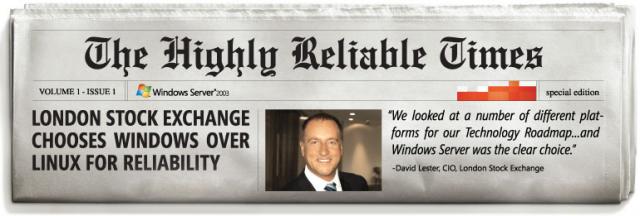
What software stack runs the LSE? Windows 2003, .NET and Microsoft SQL Server. You may remember these ads:reliabletimes

Now, I doubt we’ll ever get any real details on what actually happened. There’s some speculation that an errant application upgrade may have been at fault. Five nines is really difficult to achieve though, and it seems to me that most times you see high profile installs like the LSE that go with a 100% Microsoft stack it’s Microsoft marketing and dollars that lead to the decision – not sound technical recommendations. The NYSE may be feeling a bit better about their recent decision to move to Linux.

–jeremy

OSCON leaving Oregon and moving to the Bay

While I heard quite a few rumors about this happening, it was still a bit sad to see that OSCON is officially leaving Portland. It’s not that I don’t like San Francisco, I actually like it quite a bit. It’s that even those of us that don’t live in the Bay Area are there quite a bit. I always looked forward to OSCON because it was the only time I ever made it out to Portland. The linked article also makes mention of the possible demise of LinuxWorld, which Melinda refutes in the first comment. It will be interesting to see what the announcements she references are.

–jeremy