I’m an avid runner. And while I’ve run with an Android phone and various apps for quite some time, I’ve been increasingly wanting an Android Wear device that would make my many Garmin wearing running mates covetous. Enter the Moto 360 Sport, one of the first true Android GPS-enabled running smart watches. Considering how much I liked the Moto 360 Gen 2, I was eagerly awaiting the 360 Sport, which was announced at the same time as the Gen 2 but had a later release date.
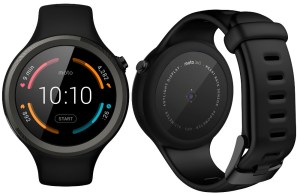
The 45mm device comes with the same size 1.37″ display (including flat tire) as the Gen 2, but the AnyLight Hybrid display makes it easily readable even in sunny conditions. The silicone strap comes in Black, White, and Flame Orange but as it’s part of a unibody construction it is not changeable. While many reviewers have found the strap to be a lint magnet, after over a month of use I did not find that to be an issue. The device has an optical heart rate monitor, barometric altimeter, accelerometer, ambient light sensor, gyroscope and a 300mAh battery. Like the Gen 2, it is IP67 dust and water resistant.
Moving on to using the device, I found the construction to be solid and the watch comfortable to wear even during long runs. Most popular running apps have Android Wear support at this point, although I’ve found most (I regularly use both Strava and Endomondo and extensively tested Runtastic, Runkeeper, Map My Run, and Ghostracer) have at least one annoying issue that needs to be addressed before being a true competitor to dedicated running watches. The platform also seems to be a bit temperamental, which resulted in me missing out on data points for a couple interesting runs. For example, the data for my Boilermaker run (a 15k) shows over an hour of activity but a distance traveled of zero. That particular issue seems to related to a known bug with Endomondo and Wear devices that have GPS. On the note of the GPS, I found it to be roughly as accurate as my phone GPS, although getting a lock takes substantially longer. It’s less useful than I hoped though, as using the GPS and active display means the battery life isn’t sufficient for longer runs. The device has 4GB of internal memory which you can play music from, although I did not test this feature. I found the heart rate monitor to be accurate enough to be useful and a nice addition to my running metrics.
So, what’s the verdict? Although the Moto 360 Sport lacks more advanced features such as cadence and VO2 max, it’s a very capable device. For shorter runs it will allow you to leave the smartphone at home, and for long runs being able to see stats during your run while being able to move your phone from an armband to a pouch makes for a more enjoyable experience. The display really is top notch. With the original MSRP of $299 already marked down to $199 it’s a device I would have tacitly recommended now and as the platform matures I could have seen that turn into a much stronger recommendation. I was definitely looking forward to the second iteration of the device.
Enter Motorola Support
Unfortunately after 47 days of use, the device rebooted while I was running then shut off. Once I got home and put it on the charger it went into a boot loop. I did some research online and found out some other people had a similar issue. While most weren’t able to fix their device, I found one suggestion that involved completely draining the battery then charging it overnight. This worked a single time, but during the next run the device shut off and further research and troubleshooting were not able to resuscitate it. I was a little bummed, but these things happen with electronic devices and I went to the Motorola support site to start the RMA process. This is where the experience gets unfortunate and things did not start out well.
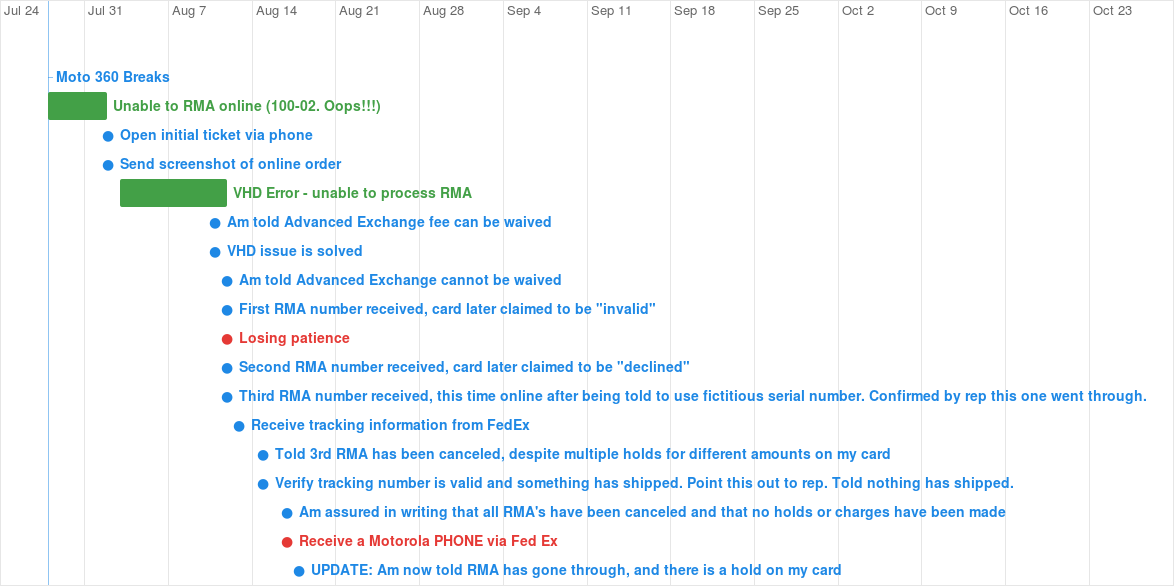
I tried multiple times to begin the process online, but received the following error: “100-02. Oops!!!” After that error persisted for a few days, I finally called support. Unfortunately support was not able to verify the serial number on my device, despite multiple attempts which included me sending them a photo of the sticker affixed to the box which contains both the SKU and serial number. After some back and forth I ask for an RMA despite the serial number issue, as the device comes with a year warranty and has not been out for even close to a year yet. I understand they have legitimate reasons for needing the serial number, but they can get that off the device once they have it. In this context, it’s not needed to validate warranty coverage. The rep said they could not proceed without a “scanned copy of the receipt”, despite me pointing out that 100% of Moto 360 Sports have to be in warranty. I also explained that as this is 2016 I purchased the device online and do not have a receipt to scan. After some additional back and forth, on August 2nd I send them a screenshot of the online order, while also pointing out this is a pretty silly thing to have to do. At this point I just want to get the process moving.
On August 4th I get a response saying: “In regards the replacement/repair process, we get an error from the system, in that case we opened a VHD ticket which is going to have a resolution within 24 to 48 business hours”
On August 8th, I get an update: “I wanted to let you know that I am following up your case, and that I have not received confirmation that the VHD ticket has been solved, but I already verified with the team in charge of it, they told me they are working on it.”
At this point I reach out to @Moto_support, but am told: “Please follow up with us via email”. I also now note that I am using this device to write a review for a site that gets quite a bit of traffic, hoping that will help expedite things. It does not.
On August 10th, I get an additional update: “I am contacting you to provide you updates about the VHD ticket submitted, it is still being worked by the team in charge.” It’s now been over a week since I initially opened a ticket with the support rep.
On August 11th the VHD issue is solved. They want me to ship them the device so they can evaluate it and then either repair or replace it, or give them $25 for the “Advanced Exchange program”. I explain that after over a week of waiting, the fee on the AE program should be waived and a device should be sent ASAP. They eventually agree. Via the email ticket I give them all contact information as requested. Shortly after I get a voice mail from Motorola with no callback number and no email contact info that ends with “just email us back, okay”. I guess this means reply to the ticket, which I do.
On the 12th, I get a call from Motorola. They now say the fee cannot be waived because the system will not let this happen, but it can be refunded after the fact. I point out that this directly contradicts what was previous said by them. They persist. I eventually capitulate and give them my credit card information. The experience at this point is getting really frustrating and taking up far too much time (believe it or not, this is just an overview of the event which included quite a few calls and back-and-forth emails over trivial issue and re-re-re-confirming information). I get an RMA email while I am still on the phone with the rep, which is encouraging. I just want to run and I now think a new device is on the way. I am sorely mistaken.
A short time later I get an email saying the credit card is “invalid”. We confirmed the number on the phone three times; it is not invalid. During the next call I note that it’s odd that the card would be invalid as I received an RMA. I am told: “even though you received shipping labels or tracking numbers, the system sends the emails automatically, that is why you received them, but in the system they did not go through”. This makes no sense, but I give my credit card details again. I get another RMA while on the phone, but notice that it’s for the incorrect device (a Moto 360 Gen 2, not a Moto 360 Sport). Looking back, the first RMA was also for the incorrect device. It is explained to me that this is normal and not an issue. A couple hours later I am told that my credit card was now declined. I have used this exact card before and after the RMA and the card is nowhere near its limit. I call the credit card company. There have been zero attempts from Motorola and zero declined transactions for the day. I am now starting to lose my patience.
On the next call I explain that the number is correct and the card has not been declined. They suggest I try to submit the request online again. I get the same “100-02. Oops!!!” error. I point out how ridiculous this is getting. The rep now suggests that I use a different serial number than the one that is on the box. This does not seem normal. Using the new serial number does get me past the previous error, however, and may explain the incorrect device issue. I now get a credit card error. I point out that it’s odd that the system never asks for a CVV, but they don’t seem to know what I am referring to. I try the online system again with a new card. One that has a zero balance and that I rarely use. This time I am met with success. They double check the system and everything looks good. Hooray!
Except, no. On the 15th I get an email: “I am contacting you to provide you updates about your case, I was checking it, and I found that unfortunately the order is cancel for invalid or missing Credit Card number”. I explain that this is odd even for this increasingly odd situation as I now not only have a 3rd RMA, which has been confirmed by Motorola, but a tracking number from FedEx. Surely the tracking number means a replacement device is on the way. I am told: “You have received FedEx shipping confirmation because shipping information and credit card information are being processed by a different systems.” I check my credit card statement and I have two pending transactions for different amounts:
Aug 12, 2016 MOTOROLA MOBILITY LLC $244.68
Aug 12, 2016 MOTOROLA MOBILITY LLC $250.86
They now ask for a “bank statement”. I tell them in no uncertain terms that they are not getting one and am now starting to lose my temper. They ask me to submit the request again from scratch. I point out how absurd this entire interaction has been and also note that the Fed Ex tracking number they gave shows that something has actually shipped. Between that and the pending charges, I think their system is incorrect and the third RMA has been processed. They do not agree. They also do not have an explanation for the multiple charges for different amounts, neither of which they see on their end.
On the 16th they touch base on the ticket. I respond with: “To confirm: All RMA’s have failed in some way and nothing has shipped, despite me receiving a tracking number. Is that correct?”
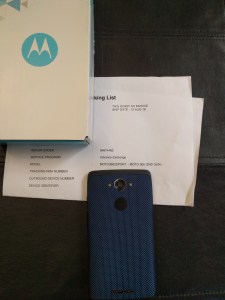
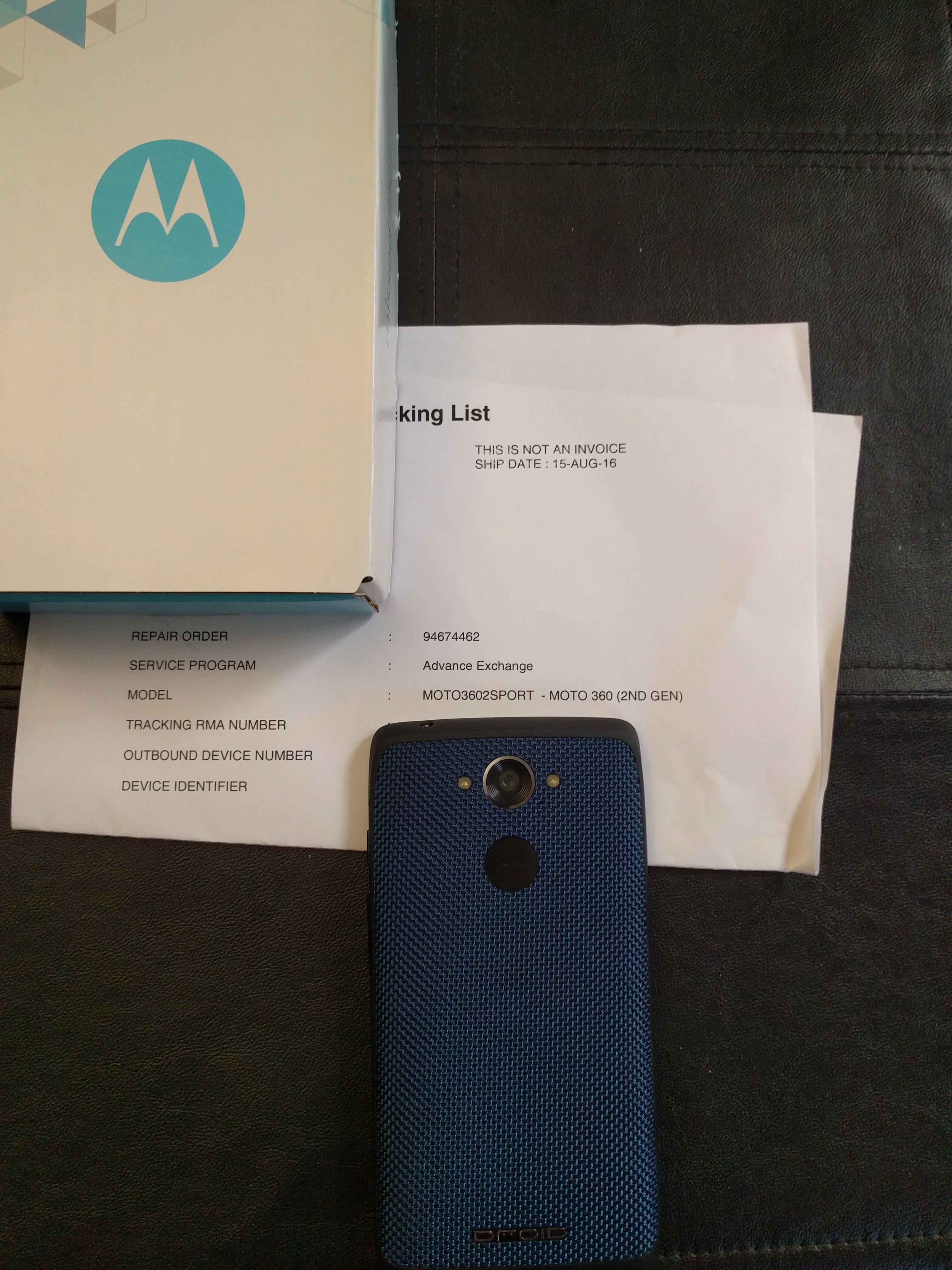
I received the following response on August 17th: “That is correct all RMA’s have failed, and nothing has been shipped despite the tracking numbers you received.” I also received a package from Motorola. Containing a Motorola DROID phone. A PHONE! I can’t even begin to fathom how that’s even possible, considering the packing list actually says “MOTO3602SPORT – MOTO 360 (2ND GEN)” on it. I called my credit card company again, and at no time were any transactions declined. They do see both pending transactions from “MOTOROLA MOBILITY LLC” but “they are set to fall off your account because they were never finalized by the merchant”. Once they are no longer pending, I figure the phone is a gift and I plan to see if the Moto 360 Sport will blend. The DROID is a Verizon model, if anyone knows a charity in need please contact me. In the mean time, I’m in the market for an Android Wear running watch.
Based on the above experience I must unfortunately recommend avoiding all Motorola products at this time, which is a shame. The outrageously bad support is a large blemish on a company that is putting out solid quality products. I still think the Moto 360 Gen 2 is one of the best Android Wear watches currently available. In fact, I’ve purchased the device for family and friends and it’s been very well received. Quite a few people have told me they purchased one based on my review and the feedback has been positive. I like the Moto 360 Sport and some of the phones look very nice. That said, the support experience above was so terrible, the Motorola internal systems are so broken and the issues so systemic in nature that I would not feel right if one single person had to go through the above based on a recommendation I have made. So, at least for now, keep away. Far.Away. And Motorola Support, please get your act together.
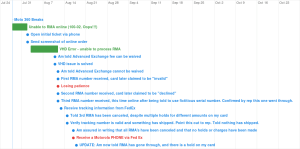
Note: Any text in quotes above are a direct copy/paste of the interaction. Luckily I have much of this in writing or on voice mails, but some did take place on the phone. Happy to provide supporting details if so desired. I have reached out and it appears I am not alone in this kind of experience with Motorola Support.
UPDATE: They are now mysteriously able to see that the RMA “went through, and I can see the device arrived to your home”. The rep also added: “I will ask you to send us the device since with the Advance Exchange submitted a hold has been put on the card you used, if you do not send us back the device the hold will become a charge.” which is in direct opposition to the statement I have in writing from the 17th that confirms there are no holds on my card. Let it sink in for a minute that the system they use is so bad, they don’t actually know if they are billing you or not.
UPDATE (August 19th): Someone from the “Executive Customer Relations” team (which based on the email address appears to be part of the office of the CEO) reached out to me. They included a tracking label to overnight the phone to them and said they would overnight me the correct watch as soon as they received the phone. So, progress. I had the phone to FedEx within an hour, and noted it would be a show of good faith for them to overnight me the watch now, since the issue has been going on for roughly three weeks already and we’re getting to the weekend. They responded, and insinuated they could do so but would not as a result of something I said in this post (the comment about the phone being a gift). My response: “Considering the show of good faith I made by having the package at Fed Ex within an hour of receiving your email AND the fact that we are on week three of this absolutely terrible customer experience AND the fact that I provided proof of shipping AND the fact that we’re on a weekend boundary that will cause another delay, I’m hoping you decide to ship something out ASAP”. I also included a photo of the Fed Ex receipt. They never responded, which is pretty disappointing and seems for lack of a better word…vindictive. I guess I’ll now be running at LinuxCon with no Moto 360 Sport. I also made it clear that this is no longer about me getting a working device. The readers, listeners and conference-goers that I have recommended Motorola products to or whom have seen me wear the device on stage and have made a purchase as a result deserve to know the systemic issues I encountered are being addressed. They completely ignored that part of my email but I will work to get it addressed. Stay tuned for further updates.
UPDATE (August 20th): After posting the previous update I also sent a very frank email to the Executive Customer Relations team. They had received the phone at this point and responded saying they decided to send me a new Moto 360 Sport via Saturday deliver, which I just received. Hopefully this marks the end of my particular issue. On to the broader issue, they said “We have completed a deep dive on your case and sent off coaching and feedback to ensure this does not occur in the future”, which is encouraging. I’ve responded noting that the technical system they use should really be evaluated, as the number of cascading failures just should not be possible (remember: the system allowed for the creation of an RMA when one doesn’t exist, showed one card as declined when my credit card company confirms it was not, put two holds for different amounts on a second card but then canceled the RMA while somehow still sending out a device, which then ended up being the incorrect device. The billing issues are especially worrisome and it looks doubly bad when a tech company has this many technical failures). It is my hope based on their response that they will look into the failures and hopefully other people will not have to go through an experience similar to the one I have.



 Jeremy's Blog
You must be logged in to post a comment.